Wednesday
19 August, 2026
News Flash
News Flash
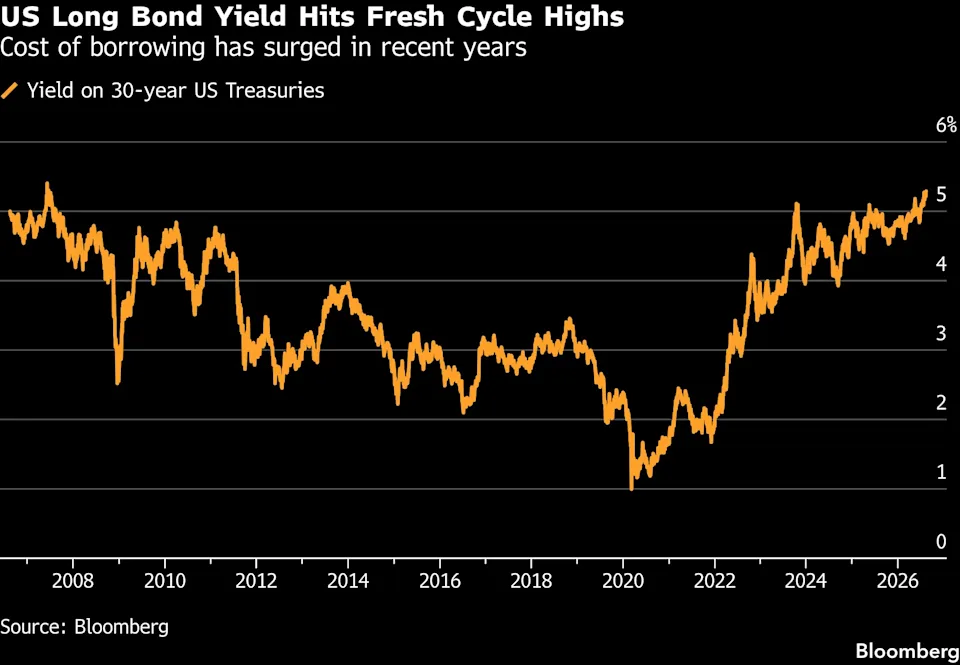
WASHINGTON, United States, Aug 19, 2026 (BSS/AFP) - Yields on longterm US Treasury bonds jumped Tuesday to the highest level since 2007, underscoring rising price pressures due to the Middle East war and mounting anxiety about American deficit spending.
The yield on the 30-year US Treasury climbed early Tuesday to 5.34 percent before pulling back. The increase forces the US government to refinance debt at the highest rates since before the 2008 global financial crisis.
The yield on the 10-year US Treasury note currently stands at 4.71 percent, compared with 3.94 percent before the first US-Israel strikes on Iran in late February.
"With oil rising towards $90 a barrel, investors are increasingly concerned about the possibility of a more prolonged inflation shock," said Fiona Cincotta, analyst at Forex.com.
US consumer inflation slowed somewhat last month, to 3.4 percent over the last 12 months, but analysts believe that lull will probably be ephemeral.
With elevated inflation expected to persist, bond investors are demanding higher yields to compensate for the value eroded over the life of the debt holding.
The current jump in yields comes after earlier spikes in May and late July that have coincided with a surge in oil prices.
"Yields are rising because the market is of the opinion that the Fed might be too slow to respond to the stubbornly high oil prices and the stubbornly high inflation," said CFRA Research's Sam Stovall.
The latest rise in yields follows the Federal Reserve's July 29 decision when the central bank kept interest rates unchanged, opting against a hike despite elevated inflation.
Market watchers pointed to a contradiction between the July Fed decision and the tough rhetoric on inflation by Fed Chair Kevin Warsh.
Rising yields are "a response to the lack of a clear steer from the Fed since Kevin Warsh took on the role of Chair and dropped all forward guidance for markets," said Saxo Markets analyst Neil Wilson.
"This has been a factor stoking the move up in the long-end of the curve in particular," Wilson said of longer-term bonds.
- Competing with AI -
But there are other drivers behind the high yields besides monetary policy, according to analysts at Commerzbank.
The US national debt has passed $39.9 trillion, according to US Treasury figures, almost double the level from 2010, and all signs point to that debt continuing to grow.
US officials last week oversaw a pair of auctions for 10- and 30-year bonds raising $67 billion at the highest yields since 2007 and 2001, respectively.
The government also must compete with corporate bond offerings at a time when the technology sector has embarked on hundreds of billions of dollars in US investment in 2026 alone.
Higher yields translate into increased mortgage rates as well as higher interest rates on business loans, car loans and credit card payments.
"Higher interest rates lead to higher costs," Stovall said. "And typically, businesses and consumers will do what they can to lower those costs, possibly by just curtailing their expenditures."
Such unfavorable lending conditions -- combined with higher gasoline prices -- have weighed on Donald Trump's political standing, posing challenges to the president's Republican party in the upcoming midterm elections.
The United States is far from alone in confronting increased bond yields as the jump in oil prices reverberates through the global economy.
Bond yields in Japan have surged to their highest level in decades, a dynamic that is also playing out in France and Germany.