Wednesday
12 August, 2026
News Flash
News Flash
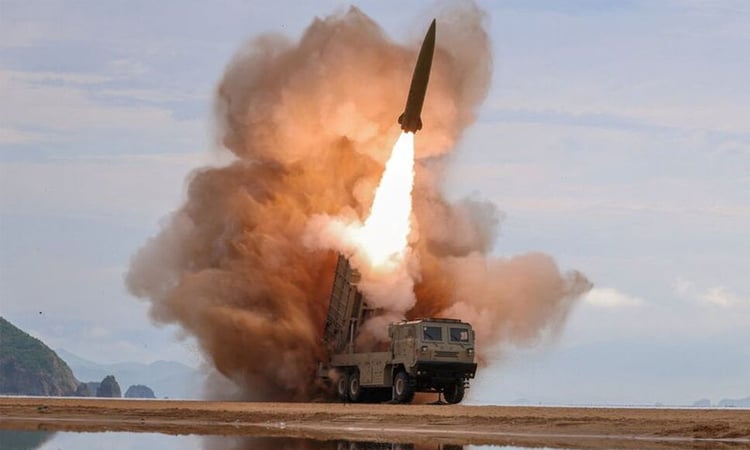
SEOUL, South Korea, Aug 12, 2026 (BSS/AFP) - North Korea fired a ballistic missile off its east coast towards Japan early on Wednesday, Seoul's military said, days before the planned start of massive US-South Korea joint drills.
The 11-day exercises due to begin on Monday are a regular fixture of the summer calendar, designed to steel the United States and South Korea for defence against the nuclear-armed North.
Pyongyang calls them rehearsals for an invasion and has staged missile launches before and after them in the past.
"Our military detected at around 6:00 am (2100 GMT on Tuesday) a ballistic missile launched by North Korea from the Wonsan area towards the East Sea," Seoul's Joint Chiefs of Staff said in a message to reporters.
The missile flew more than 700 kilometres (435 miles) over the body of water -- also known as the Sea of Japan -- it said, adding that Seoul and Washington were analysing its specifications.
Japan's defence ministry also described the object as a suspected ballistic missile, adding that it was thought to have "already fallen", without providing further details.
"North Korea has never simply let a South Korea-US joint military exercise pass without a response," Lim Eul-chul, a North Korea expert at Kyungnam University, told AFP.
"This is a message that Pyongyang is closely watching the upcoming drills and could stage a provocation if it deems one necessary."
Japan's Defence Minister Shinjiro Koizumi called Wednesday's launch a "threat to peace and security in our region" and said Tokyo had "lodged a strong protest" with North Korea through diplomatic channels in Beijing.
North Korea has recently been hurling criticism at Japan, a former regional colonial power, over what Pyongyang describes as its remilitarisation.
Conflict experience -
Japan has long held a pacifist stance, but has been increasing military spending, ramping up defence pacts and deploying missile launchers to its outer islands.
Koizumi said last week that Japan needed to boost its military with a "sense of urgency and crisis".
Pyongyang lambasted Japan's "transformation into a war state", and shortly afterwards fired a short-range ballistic missile off its eastern coast, according to Seoul's military.
Tokyo's governor announced plans last week to convert a 13,000-square-metre (140,000-square-feet) subterranean carpark into an underground missile shelter near Tokyo Station.
In the past, North Korean missiles have flown over Japan, triggering sirens, smartphone alerts and special programming on television.
As of April 2025, there were 61,142 shelters across Japan, but less than seven percent were underground, according to government data.
South Korea's national security office convened an emergency meeting on Wednesday, where participants called recent launches "provocative acts" and demanded Pyongyang "immediately halt them".
North Korea has been playing a more active role in international conflict, notably backing Russia in its invasion of Ukraine.
Ukraine accused Russia on Tuesday of launching North Korean missiles in an attack that killed 10 and wounded dozens.
Ukrainian President Volodymyr Zelensky has also warned -- without providing evidence -- that Moscow has been receiving more ballistic projectiles and troops from Pyongyang.
Experts say North Korea has received financial and military benefits from Moscow in return for its support.
Its troops have also gained crucial experience on modern battlefields.
The US-South Korea "Ulchi Freedom Shield" drills due on Monday will include 18,000 South Korean troops and counterparts from the US contingent of 28,500 in the country.
A spokesman said they will prepare soldiers for a potential fight against North Korean troops battle-hardened from deployment in Europe.
North Korean soldiers have "taken those lessons they learned there and brought them back to North Korea", Colonel Ryan Donald, spokesman for the US and South Korean Combined Forces Command, said on Monday.
"Our training accounts for that threat," he told reporters.